Water Heater Repair
Sort out leaks, lukewarm showers, popping noises, pilot trouble and tripped breakers.
Tankless units heat water on demand, and hard water coats their heat exchangers with scale. Regular flushing keeps them running, and a unit that throws error codes may need more than a flush.
Give the make, the model and any error code when you call.
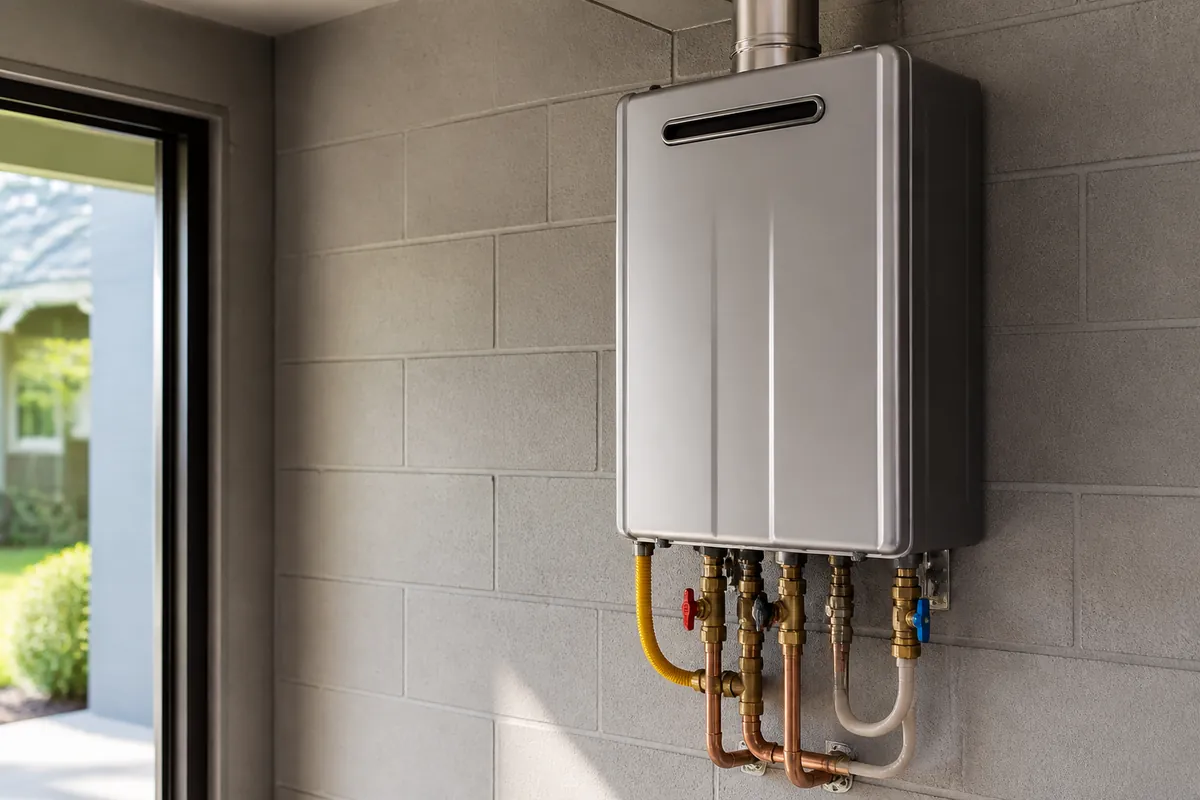
A flush circulates descaling solution through the heat exchanger to dissolve mineral buildup. Many manufacturers advise doing it on a schedule, and hard water makes it more necessary.
A unit that has never been flushed may have heavy scale. Ask the contractor how they judge the buildup and what the service covers.
Error codes point to a category of fault, such as ignition, flame sensing, venting, flow or temperature. A code tells the contractor where to look.
Jot down the code and request a written note of the repair.
Phoenix water tests at roughly ten to seventeen grains of hardness per gallon in the city's own reporting, which is hard enough to build scale in a heat exchanger. A softener or a scale filter ahead of a tankless unit is a common question.
Service pricing follows the work and the unit.
Ask what the service includes and whether parts are separate.
Gas tankless units need venting and a gas supply sized for the load. Electric models need heavy wiring. Hybrid heat pump models need clearance and a condensate line.
Ask whether the contractor works on your brand. Some specialty models need factory parts.
A newer unit with one failed part is worth fixing. An older unit with heavy scale damage may not be.
Tankless units are compact but still need care.
Hard water leaves scale inside the heat exchanger, and a flush with descaling solution clears it. Many makers advise periodic service, so ask the contractor what yours requires.
Clean the inlet filter and check the vent. A neglected unit may lose efficiency or trip faults.
Many faults are repairable. A sensor, a valve or a fan can be swapped. Ask for a diagnosis before replacing. When a unit is past help, replacement is the next question.
Write down the error code and the model number on the label. Note when the problem started and how the water behaves. Shut off the unit if it is leaking.
Sort out leaks, lukewarm showers, popping noises, pilot trouble and tripped breakers.
New softener setups, plus help when a unit stalls, leaks or runs over.
A failed tank swapped for a new one, with sizing, fuel, placement and permit questions sorted out.
Follow the maker's schedule, and flush more often with hard water.
Codes point to faults such as ignition, flow or venting. A contractor can diagnose it.
Yes, if demand is greater than the unit can supply. A contractor can check whether it is sized correctly.
Ask on the call, and have the brand and model number ready.
Call any time. A unit that leaks or throws a fault code should be shut off and reported. The contractor decides the timing.
Follow the maker's guidance. Hard water may justify more frequent service.
Many can. Parts availability depends on the brand.
It points to a fault area. The manual or the technician can read it.
Note the code and call. A contractor can be arranged from there.
Service area centered on Laveen and nearby Maricopa County cities.